

An Ode to Learning Through Translation
Sometimes old is still gold.

In less than two months of Latin and Ancient Greek at Italian high school, I could read 10-line texts with barely any difficulty. And I underline that I could do it even in Ancient Greek - because for an Italian, the easy Latin sentences you study in the first months are less of a challenge.
After three years of German at school using the communicative method, I was still struggling miserably with texts at a similar level.
The best coursebook I've ever used was for Persian, first published in 1977. Pure grammar, vocabulary lists, translation exercises. No games. Modern coursebooks are full of too passive exercises - fill in the blanks, reorder the words, circle the right answer. You reelaborate language that's already there. You never produce a full sentence from scratch, alone, with nothing to lean on - you do it in speaking sessions, but in my experience the time is rarely enough to properly digest how a language works.
If I think about my situation with German, I would just put words together without any clue about whether they were actually correct or not - a huge chaos in my mind. The same could have happened with Dutch and French too, but I had the pure luck of having people to talk to - as I explain here and here - so I could fix the mess in my brain before it got too serious.
That's why, now that I’m building my Dutch and Italian mini courses, I based them on the same logic. They're still in progress, but you can already take a look. It's not trendy, but it works.
A few days ago I posted a note about this. I wasn’t expecting what I read in the comments, I was really positively surprised, because I expected to be the usual black sheep…
“A lot of “modern” language teaching focuses on exposure without structure, but grammar + translation build real understanding. When learners understand why a language works, reading becomes decoding meaning instead of guessing. That’s why methods rooted in logic and active translation often create much stronger long-term results — even if they’re considered old-fashioned today. And honestly? If a method keeps helping people actually read, think, and communicate in another language… it’s timeless, not outdated.” - Francesca from @readitalianwithme
And then Spanish Makes Sense added here:
“Using translation as a learning tool has been heavily criticized. In many courses, students are told “don’t translate” or “don’t think in your native language,” However, when we use it, we can see how effective it is straight away. We can understand certain words better and faster. This increases our sense of comfort, which, in turn, keeps us motivated.”
So… think about it :)
Let me be concrete about what I actually do.
I think in Italian (mostly). I translate as literally as possible - with a pinch of salt. That pinch of salt means I look for phrases and collocations, not individual words or at least I pay attention to the domain a word belongs to.
Otherwise - as a foreigner learning Italian - I might end up calling a chip a 'circuito integrato' (integrated circuit) instead of a 'patata fritta' (fried potato) - because 'chip' can actually be translated both ways. This risk was especially relevant in the pre-AI era though.
It's still there, but incredibly lower than when you had to hope to find enough context in whatever dictionary you had managed to find.
The literal instinct gets me close. The context corrects me. I learn from the gap between the two. Which means:
I keep throwing things and seeing what sticks
I have to be comfortable making mistakes.
This has earned me results that are very often above average, just by doing what's considered 'unorthodox' - or the opposite of what too many teachers preached at me. Luckily, I'm not alone.
Theory gives you the skeleton, but the muscle comes from being wrong.
This is linked to the generation effect. Making a wrong attempt before seeing the correct answer produces stronger long-term retention than studying the rule first. Errorful learning, the researchers call it. Your brain encodes the correction more deeply precisely because it had to work for it.
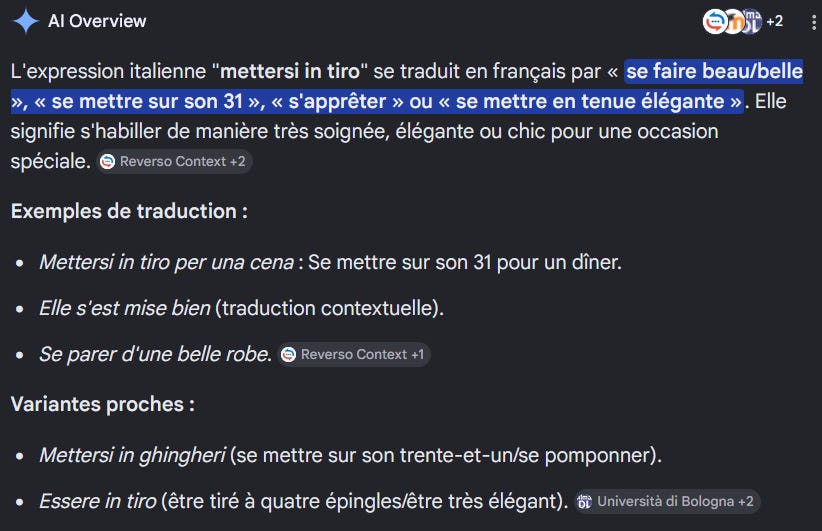
The best way for me to learn new vocabulary is realising that once I’m fluent enough with my basic word toolkit, I can go and look for exactly the right expression I need.
What do I do? I just Google it!
I don’t expect to learn all of them immediately. Most probably I forget most of them, but if I do it’s likely because I don’t need it enough in my life. And that’s fine because I hate learning for the sake of learning. If I had to, this would be my way to go and I try to use this system less occasionally than usual for Dutch, but that’s all.
A few days ago I wanted to tell a friend in French that I had 'got all dolled up' for an event, so I looked it up - I didn’t know that expression. The reaction of my friend made me understand that “se mettre sur son 31” was actually perfectly fine - and he added a couple of further options just to help me (kindness level: Belgian).
That’s all, that’s my secret and that’s why I wrote this ode.
One last thing.
The Frequency Circle - my community where members write 2 to 3 times a week in their target language and I respond with questions and feedback - is open at its Founding Member price of $12 per month until tonight, May 15. After that it goes to $23 (roughly 20€).
The community is public, check the calendar for the live meetings and the classroom for the minicourses too, so you can look inside before joining: skool.com/frequency-circle-1437
I’d recommend giving it at least a month, if I gave a free trial week it wouldn’t be enough to properly feel the difference.
Translation isn’t old fashioned.
It’s just honest.
Chiara
No newsletter on Tuesday - this was it. See you on the 26th.
Great post Chiara! And thank you fir the mention 😊
Hi Chiara,
It’s a pleasure to participate in this discussion.
I’ve really enjoyed reading your post, and I’ve found many insights in it that I’ve had but hadn’t been able to put into words.
It's definitely worth saving this post and coming back to it later to explore it further.